Table of Contents
- Why Small Garden Tree Trimming Matters
- When to Prune Garden Trees
- Tools and Safety Equipment You'll Need
- Tree Preservation Orders: What You Need to Know
- Step-by-Step Process for Small Garden Tree Trimming
- Professional Tree Crown Reduction for Larger Jobs
- Common Mistakes to Avoid
- When to Call a Professional Tree Surgeon
- Frequently Asked Questions
Last Updated: September 28, 2026
Why Small Garden Tree Trimming Matters
Overgrown trees create problems. They block light from reaching your garden. Branches hang over fences and pathways. Disease spreads through crowded growth. Dead wood becomes a safety hazard.
Small garden tree trimming isn't just about appearance. It's about keeping your property safe and healthy. Proper trimming improves tree health by removing diseased branches. It opens up your garden to natural light. It prevents branches from damaging fences, sheds, or your home.
A well-maintained tree lives longer and looks better. Neglected trees become liabilities. The difference between the two comes down to timing and technique.
When to Prune Garden Trees
Timing matters more than most people realise. Prune at the wrong time and you stress the tree or encourage disease. Prune at the right time and the tree recovers quickly.
Late autumn through early winter is ideal for most deciduous trees. The leaves have fallen. The tree is dormant. You can see the branch structure clearly. Sap is low, so cuts heal better. Avoid pruning in spring when new growth is emerging, or in summer when the tree is under heat stress.
Evergreens like conifers need different timing. Trim them in late summer or early autumn. Never prune in winter or early spring when frost can damage fresh cuts.
When NOT to prune:
- Spring: New growth is vulnerable to frost damage
- Summer: Heat stress weakens the tree's ability to heal
- During heavy frost: Cuts won't seal properly
- After heavy rain: Wet branches are heavier and harder to manage safely
According to the Royal Horticultural Society's guidance on tree care, understanding your tree species is essential before you start any work. Different trees respond differently to pruning, and timing varies by type.
Tools and Safety Equipment You'll Need
The right tools make trimming safer and more effective. Dull tools require more force and slip more easily. Sharp tools cut cleanly and reduce strain on your body.
Essential hand tools:
- Bypass secateurs for branches up to 10mm thick
- Loppers for branches 10-25mm thick
- A sharp pruning saw for larger branches
- Pruning knife for smoothing cuts
Safety equipment is non-negotiable:
- Safety glasses or a full face shield
- Work gloves rated for cutting
- Steel-toed boots with good grip
- High-visibility clothing so you're visible to others
- A first aid kit nearby
For branches above head height, you need a ladder or step stool. Never overreach. Never work on a ladder alone. Secure the ladder on level ground away from the tree.
Tree Preservation Orders: What You Need to Know
A Tree Preservation Order (TPO) is a legal protection placed on trees by local councils. If your tree is covered by a TPO, you cannot trim it without permission from the council. Breaking this rule carries fines up to £20,000.
Check with your local council before trimming any significant tree. Search their planning portal or call the planning department directly. They'll tell you if your tree is protected.
Trees automatically protected:
- All trees in conservation areas (even without a specific TPO)
- Trees listed in a formal Tree Preservation Order
- Trees on land with planning permission restrictions
Even routine maintenance on a protected tree requires written council approval. The council typically responds within 8 weeks. Emergency work (like removing a dangerous branch after a storm) may proceed without approval, but you must notify the council afterwards.
According to the UK Government's guidance on Tree Preservation Orders, councils have the power to protect any tree in their area. If you're unsure, always ask first. The cost of permission is nothing compared to the cost of a fine.
Step-by-Step Process for Small Garden Tree Trimming
Total time: 2-4 hours for a small tree (depending on size and complexity) Difficulty: Beginner to intermediate
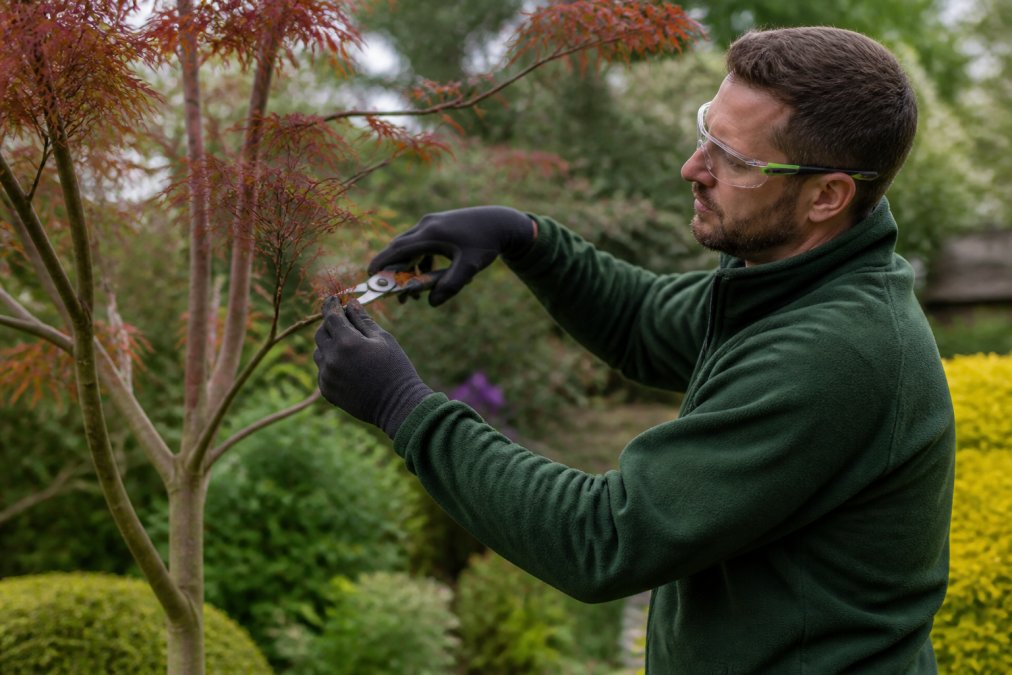
Step 1: Assess the Tree's Health and Structure
Before you cut anything, understand what you're looking at. Walk around the tree. Look at the overall shape. Identify dead branches (they're grey and brittle). Look for branches that cross or rub against each other.
Check for signs of disease: black spots, oozing sap, peeling bark, or unusual growths. If the tree is diseased, you may need professional help. Some diseases spread when you cut, so improper trimming makes things worse.
What to look for:
- Dead wood: grey, brittle, no leaves or buds
- Diseased branches: discoloured bark, oozing sap, fungal growth
- Crossing branches: two branches growing into each other
- Inward-growing branches: growing toward the centre rather than outward
Expected result: You understand the tree's current state and have identified which branches need removal.
Step 2: Remove Dead or Diseased Branches
Dead wood is the safest place to start. It won't regrow. It won't stress the tree. Dead branches come off first.
Cut dead branches back to the branch collar (the swollen area where the branch meets the trunk). Use a clean, sharp cut at a slight angle. Never leave a stub. Never cut flush to the trunk, that damages the collar and slows healing.
For diseased branches, cut well below the visible disease. Disinfect your tools between cuts if disease is present. Wipe blades with a cloth soaked in methylated spirits.
How to make the cut:
- Position the blade just outside the branch collar
- Cut at a 45-degree angle, sloping away from the trunk
- Make one clean cut; don't saw back and forth
Expected result: All dead and diseased wood is removed. The tree looks cleaner and healthier.
Step 3: Thin Overcrowded Growth
Crowded branches block light and trap moisture. Thinning opens the canopy and improves air circulation.
Look for branches that cross or touch. Remove the weaker of the two. Look for branches growing inward toward the centre. Remove those. The goal is a canopy where light reaches most areas and air flows freely.
Don't remove more than 25% of the canopy in one year. Removing too much stresses the tree and can trigger excessive regrowth.
Branches to remove:
- Crossing or rubbing branches
- Branches growing inward
- Branches that are obviously weaker or smaller
- Branches that block significant light
Expected result: The canopy is open. Light reaches the ground below. The tree looks balanced and healthy.
Step 4: Shape for Aesthetics and Light
Now you shape the tree to your preference. This is where trimming becomes an art.
For formal shapes, work gradually.
Shaping principles:
- Work gradually; step back often
- Keep the tree's natural shape in mind
- Avoid flat-topped or heavily squared-off shapes (they look unnatural)
- Maintain a wider base than top (better structure)
Professional Tree Crown Reduction for Larger Jobs
Sometimes a tree is too large or complex for DIY trimming. Crown reduction is a professional technique that reduces the overall size and weight of the canopy.
When to hire a professional:
- Tree is over 6 metres tall
- Branches are over 50mm thick
- You're uncomfortable working at height
- The tree is protected by a Tree Preservation Order
- The tree shows signs of disease or structural weakness
Common Mistakes to Avoid
Most DIY trimming fails because of a few preventable errors. Avoid these and your tree will thrive.
When to Call a Professional Tree Surgeon
Some jobs are beyond DIY. Knowing when to call a professional saves time, money, and safety risks.
Call a professional if:
- The tree is over 6 metres tall or branches are thick and high
- The tree is protected by a Tree Preservation Order
- You see signs of disease or structural problems
- The tree is near power lines, buildings, or fences
- You're uncomfortable working at height or with large tools
- The job requires a chainsaw or climbing equipment
- The tree needs crown reduction or major reshaping
- You're unsure whether trimming is safe
Frequently Asked Questions
When is the best time of year to prune small garden trees?
Late winter and early spring (February to March) is ideal for most deciduous trees, as they're dormant and pruning wounds heal quickly as growth begins. Summer pruning works for removing dead wood and shaping. Avoid autumn pruning, which can encourage new tender growth damaged by frost. Check species-specific needs, flowering trees often require pruning immediately after blooming to preserve next season's flowers.
Do I need council permission to trim trees in my garden?
Most trees on your own property don't require permission. However, if your tree is subject to a Tree Preservation Order (TPO), you must obtain written consent from your local council before carrying out any work. Trees in Conservation Areas also have restrictions. Contact your local planning authority to check if your tree is protected. Failure to comply can result in significant fines.
Can I prune my own small garden trees, or should I hire a professional?
Small, low trees with minor pruning can be tackled with basic tools and care. However, trees over 4 metres tall, those with thick branches (over 5cm diameter), trees near power lines, or any work requiring climbing should be left to professionals. Professional tree surgeons have proper insurance, safety equipment, and expertise to prevent damage to your property and ensure tree health. If you're uncertain about the work involved, get a free assessment.
What are the signs that a garden tree needs professional attention?
Look for dead or diseased branches (bare wood, dark patches, or fungal growth), significant lean or structural damage, branches overhanging buildings or power lines, excessive crowding that blocks light, or signs of pest infestation. Trees requiring work at height, removal of large branches, or those subject to Tree Preservation Orders should always be handled by qualified professionals to ensure safety and legal compliance.
Need a tree surgeon?